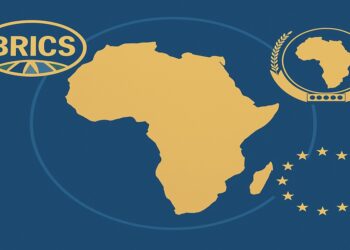


The rise of BRICS has transformed the international landscape, signaling the Global South’s growing determination to reshape the global order and loosen the grip of the Global North. What began as a platform for cooperation among emerging economies has evolved into a geopolitical force challenging long-standing Western dominance.
BRICS, initially formed by Brazil, Russia, India, China, and South Africa, has steadily expanded. With the accession of Iran, Egypt, Ethiopia, the UAE, and most recently Indonesia, the bloc now represents a significant share of the world’s population, energy resources, and economic potential.
This expansion reflects a broader movement among developing nations to redefine power not through traditional military means, but by influencing global economic and political structures.
China and Russia, the two dominant BRICS members, remain at the core of this challenge. China’s dominance in renewable energy and electric vehicles poses a direct rivalry to Europe and the United States, while Russia continues to leverage its energy resources to exert geopolitical influence over NATO.
The inclusion of resource-rich and strategically positioned nations like Iran, Egypt, and the UAE further strengthens BRICS’ ability to counterbalance Western influence.
At the July 2025 BRICS Summit in Rio de Janeiro, leaders underscored their shared commitment to restructuring international relations. The bloc openly criticized the U.S.–Israel military campaign against Iran, calling it a violation of international law, and discussed strategies to build financial and trade mechanisms independent of Western control.
The West, meanwhile, is not standing idle. The G7 has sought to engage Global South actors selectively. Former U.S. President Donald Trump once remarked: “I would say that was a mistake, because I think you wouldn’t have a war right now if Russia were still in [the G7].”
His comments illustrate the extent to which Western powers continue to monitor and recalibrate strategies toward BRICS leaders, particularly China and Russia.
Cooperation, once viewed simply as partnership, is now recognized as a new form of conflict—subtle but consequential. BRICS leverages collective power not through war, but by rewriting the rules of engagement in international politics. The struggle over the global order has entered a new phase, one defined not by conventional weaponry but by alliances, diplomacy, and economic strength.