

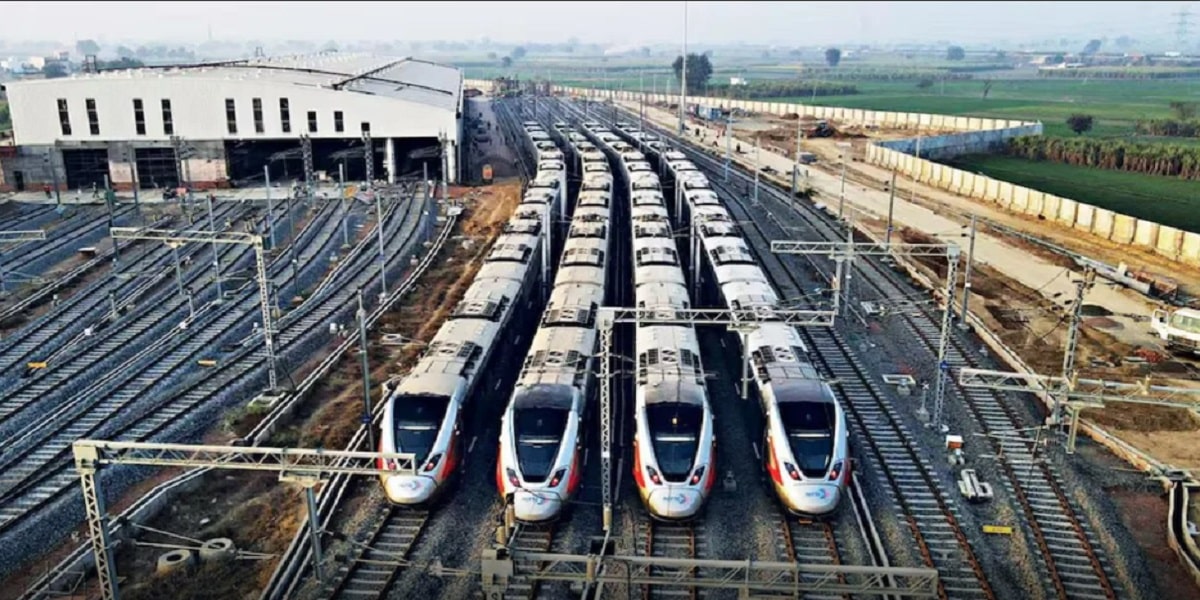
India is on the cusp of a transport revolution with the near-completion of the Delhi–Meerut Regional Rapid Transit System (RRTS), the country’s first rapid transit corridor designed to transform mobility across the National Capital Region (NCR).
Stretching 82 kilometers, the high-speed line reduces travel time between Delhi and Meerut from more than three hours to just one, marking a milestone in sustainable urban development.
As of August 2025, 55 kilometers of the corridor are already operational, connecting New Ashok Nagar in Delhi to Meerut South through 11 state-of-the-art stations. The trains, known as Namo Bharat, run at speeds of up to 180 km/h and arrive every 5 to 10 minutes, offering unprecedented convenience for daily commuters.
The project, delivered under the guidance of the Ministry of Housing and Urban Affairs and spearheaded by the National Capital Region Transport Corporation (NCRTC), is valued at over Rs 30,000 crore. Financing has been provided by the Asian Development Bank (ADB), complemented by the Asian Infrastructure Investment Bank and the Japan Fund for Prosperous and Resilient Asia and the Pacific.
NCRTC has already completed successful timetable trial runs across the full 82-km line, including the remaining 4.5 km stretch in Delhi (between Sarai Kale Khan and New Ashok Nagar) and the 23 km segment in Meerut (between Meerut South and Modipuram). The final civil and system works are progressing rapidly to ensure full-scale operations soon.
Beyond drastically reducing travel times, the RRTS is expected to cut annual carbon emissions and encourage balanced development across the NCR.
“The project marks a transformative step in India’s urban transport landscape,” said Mio Oka, ADB Country Director for India. “It not only enhances mobility but also promotes inclusive growth, environmental sustainability, and is expected to serve as a model for future regional rapid transit systems across India and the Asia-Pacific region.”
The Delhi–Meerut line is the first of several priority RRTS corridors. The Delhi–Alwar corridor, stretching 106 km through Gurgaon, is expected to receive Cabinet approval soon, signaling the beginning of a broader transformation in India’s intercity connectivity.