
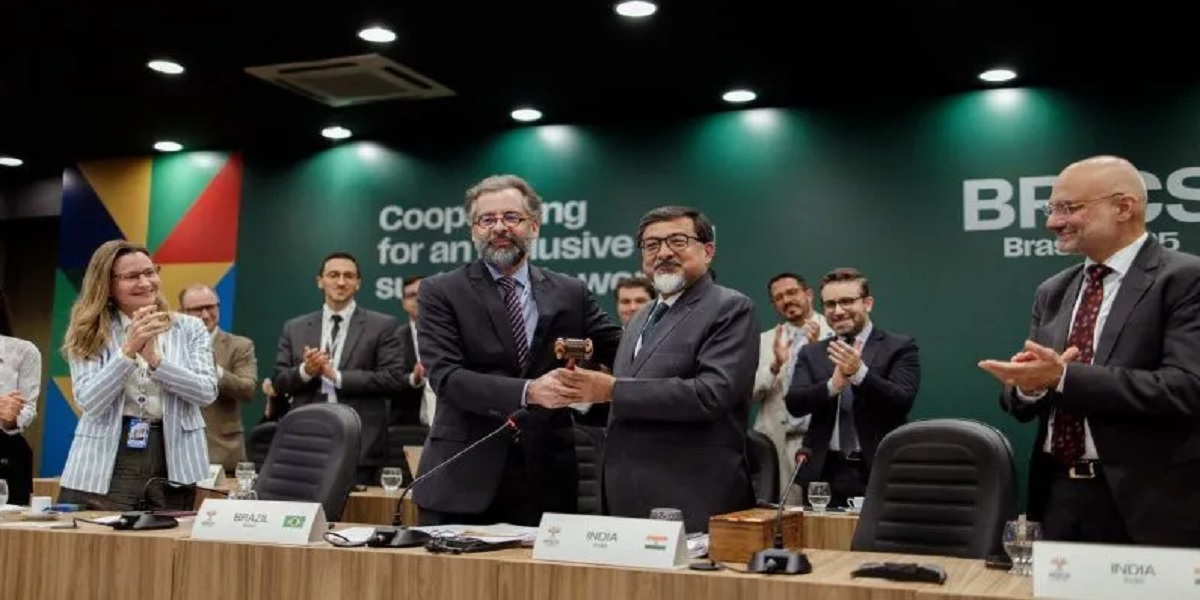
India has officially taken over the BRICS Chairmanship from Brazil following the conclusion of the 4th BRICS Sherpa Meeting on December 12, marking a new phase in the bloc’s evolving agenda. The symbolic transfer of leadership was formalized through the handover of the traditional BRICS gavel, underscoring continuity in political and diplomatic coordination among member states.
The transition was led by Brazil’s BRICS Sherpa, Ambassador Mauricio Lyrio, who passed the presidency to India’s Sherpa, Ambassador Sudhakar Dalela, after two days of intensive discussions assessing the group’s strategic direction. During the meeting, Sherpas reviewed Brazil’s presidency, which prioritized six core areas: global health cooperation, climate change, trade and finance, peace and security architecture, artificial intelligence governance, and institutional development.
In his farewell remarks, Lyrio emphasized the collaborative spirit that defined Brazil’s term.
“The discussions of the last two days reaffirm our commitment to strengthening cooperation within the group and with partner countries,” he said, adding that he looked forward to India’s leadership and the continuation of progress already achieved.
Assuming the chairmanship, Dalela praised Brazil’s consensus-driven approach, stating that “Brazil led BRICS with clarity of purpose and an admirable commitment to building consensus.” He reaffirmed India’s commitment to the principles of continuity, consolidation, and consensus, while remaining responsive to emerging global challenges and the priorities of the Global South.
India outlined its presidency priorities for 2026 around four pillars: resilience, innovation, cooperation, and sustainability. Key focus areas will include climate disaster mitigation, equitable and ethical use of artificial intelligence, and expanded scientific and research collaboration.
Political issues central to the Global South—such as reforming global governance institutions and the United Nations Security Council—will also remain high on the agenda.
The gavel handed to India carries strong symbolic meaning. Crafted from reclaimed Amazon rainforest wood by artisans from Novo Airão in Brazil’s Amazonas region, it reflects Brazil’s emphasis on sustainability, including the adoption of the first BRICS declaration on climate finance. According to Lyrio, the gavel represents “both sustainability and the deep roots of cooperation that unite the countries of the group.”
Although the ceremony has taken place, Brazil will formally remain BRICS Chair until December 31, 2025, concluding its term with a final security-focused workshop.