
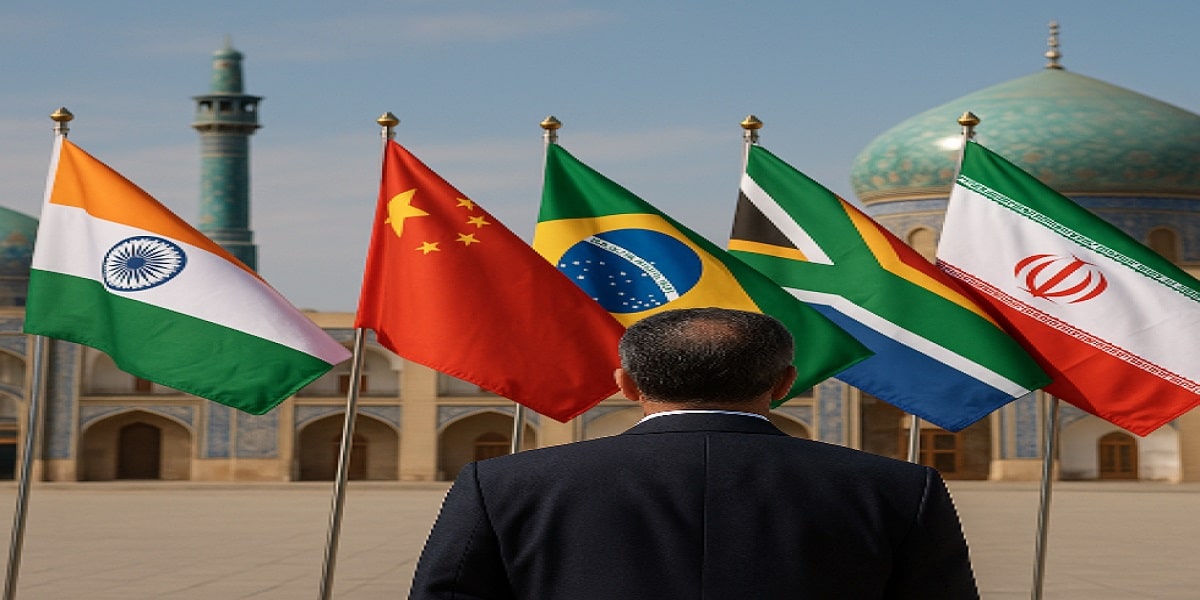
Iran’s entry into BRICS+ in January 2024 marks a symbolic step in Tehran’s long-term effort to amplify its geopolitical influence despite enduring Western sanctions.
Alongside new members Egypt, the UAE, and Ethiopia, Iran now sits within a bloc representing over 40% of the world’s population and 26% of global GDP, according to the IMF. Yet analysts agree that the practical impact of BRICS+ membership will unfold slowly.
“BRICS is mostly a platform for dialogue and sharing visions rather than a joint market or economic union,” explains Dr. Benyamin Poghosyan, Senior Research Fellow at APRI Armenia. “There is a BRICS New Development Bank, but without a unified currency or integrated market, it functions more as a forum.”
Sanctions continue to weigh heavily on Iran’s economy, limiting access to foreign investment and global financial systems. Nevertheless, Tehran has maintained oil exports of around 1.8 million barrels per day—95% of which go to China, according to the Foundation for Defense of Democracies (FDD).
The IMF estimates Iran’s oil revenues exceeded $25 billion in 2022, though heavy reliance on energy leaves the economy vulnerable to external shocks.
Dr. Poghosyan notes that BRICS+ membership “will not directly reduce the impact of sanctions, but it creates a table for dialogue and potential coordination.” In that dialogue, alternative currency settlements in yuan, rubles, and dirhams are already reshaping trade flows—especially vital for a country excluded from the SWIFT system.
Where Iran could achieve tangible progress is through infrastructure development.
The International North–South Transport Corridor (INSTC), a 7,200 km route linking India to Russia via Iran, promises to cut transport time by nearly half and reduce shipping costs by around 30%, according to the World Bank. In early 2025, Tehran and Moscow advanced financing for the Rasht–Astara railway, the missing link in the corridor’s full activation.
For Armenia and the wider South Caucasus, Iran’s expanding connectivity offers both opportunities and strategic dilemmas. Yerevan could position itself as a vital transit node between Eurasia and the Persian Gulf, provided it can integrate effectively into regional frameworks like BRICS+ and the Shanghai Cooperation Organization.
Ultimately, Iran’s BRICS+ membership reflects influence through participation rather than integration. As Dr. Poghosyan concludes:
“BRICS will not dramatically transform Iran’s economy overnight. But it gives Iran a voice — and opens long-term pathways in infrastructure and connectivity.”