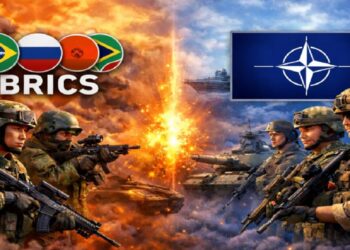


Joint naval exercises involving key BRICS members have begun off South Africa’s coast, underscoring how the bloc is cautiously expanding its geopolitical footprint without formally becoming a military alliance.
The week-long Will for Peace 2026 drills, led by China near Simon’s Town where the Indian and Atlantic oceans converge, bring together warships from China, Russia, Iran, South Africa, and partners under the wider “BRICS Plus” framework.
The exercises focus on maritime rescue operations, tactical coordination, and technical exchanges—activities South African officials frame as defensive and trade-oriented. As one senior commander put it, the drills are “more than a military exercise and a statement of intent,” emphasizing cooperation in safeguarding shipping lanes and maritime economic activity. This framing is critical at a time when global sea routes face rising tensions and disruptions.
Yet the drills also carry strong geopolitical signals. They unfold against strained relations between several BRICS states and Washington, which views the bloc as both an economic and strategic challenge.
Recent sanctions enforcement actions, tariff disputes, and sharp rhetoric from the United States have amplified the perception that these manoeuvres serve as a quiet counterbalance to Western influence, even if they stop short of forming a formal alliance.
Notably, two founding BRICS members—India and Brazil—have chosen not to participate directly. Brazil is attending only as an observer, while India stayed away entirely.
Analysts say New Delhi’s decision reflects a careful balancing act. India is navigating severe trade pressure from the US while also resisting any shift that could redefine BRICS from an economic partnership into a security bloc. As one analyst observed, India prefers “not to be tagged in the BRICS wargames,” viewing military alignment as outside the group’s original mandate.
Ultimately, the drills highlight BRICS’ internal diversity. While some members see strategic value in visible defence cooperation, others remain wary, ensuring that BRICS remains an economic coalition first—despite the growing symbolism of its naval presence.