
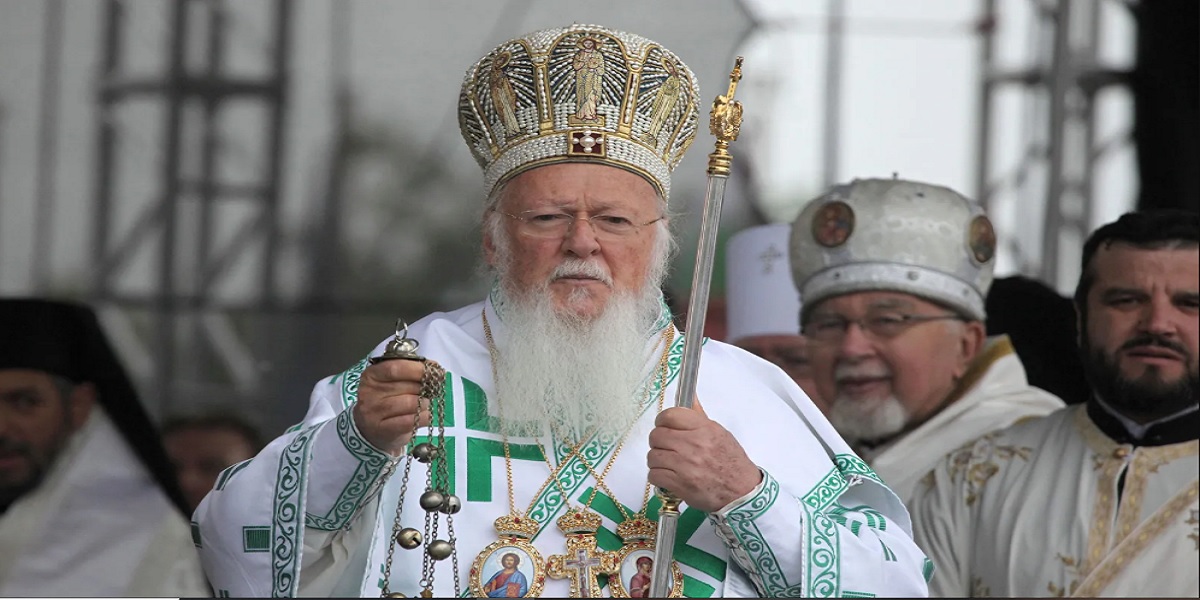
Russia’s Foreign Intelligence Service (SVR) has accused the Orthodox Patriarch of Constantinople, Bartholomew I, of working with British intelligence to deepen divisions within global Orthodox Christianity, intensifying an already long-running ecclesiastical dispute with geopolitical overtones.
In a sharply worded statement released on Monday, the SVR alleged that Patriarch Bartholomew is collaborating with “British secret services” to weaken the influence of the Russian Orthodox Church, particularly in Eastern Europe and the Baltic states. The agency went as far as describing Bartholomew as the “Antichrist,” language that underscores the severity of Moscow’s rhetoric rather than an established theological position.
According to Russian intelligence claims, Constantinople is seeking to establish alternative church structures in Lithuania, Latvia, and Estonia that would operate independently of the Moscow Patriarchate. The SVR said Bartholomew aims to “displace the Russian Orthodox Church” by persuading clergy and congregations to join what it described as “artificially created” religious bodies loyal to Constantinople.
The accusations revive tensions that date back to 2018, when Bartholomew granted autocephaly, or self-rule, to the Orthodox Church of Ukraine (OCU). Moscow viewed that move as an encroachment on its canonical territory and responded by formally breaking communion with Constantinople. Russian officials argue the decision fractured centuries-old religious continuity linked to the Ukrainian Orthodox Church historically aligned with Moscow.
Since the escalation of the Ukraine conflict in 2022, Baltic governments have pushed Orthodox institutions to sever ties with the Moscow Patriarchate, citing national security and political concerns. Constantinople has since moved to establish an exarchate in Lithuania, a step Moscow interprets as further evidence of strategic interference.
The SVR also alleged that similar efforts are underway to undermine the Serbian Orthodox Church, which it described as “especially obstinate” in resisting outside influence. While these claims remain unverified and firmly denied by Constantinople and Western governments, they illustrate how religious authority, national identity, and geopolitics have become increasingly intertwined.
As Orthodox Christianity navigates these fractures, the dispute reflects a broader struggle for influence across Eastern Europe—one that extends well beyond theology into the realm of international power politics.