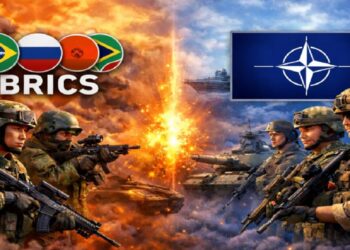


Quiet diplomacy—long the defining feature of BRICS—may finally have reached its limits. As global power competition intensifies in 2025, the bloc finds itself navigating an increasingly hostile ecosystem of sanctions, lawfare, cyber disruption, and narrative warfare.
In this environment, the absence of a formal collective security structure has become a strategic liability, raising a pivotal question: Can BRICS maintain sovereignty without building its own Security Council?
The End of “Soft-Spoken Multipolarity”
For years, BRICS operated under the assumption that restraint and patience would shield its members from Western pushback. Instead, silence created vulnerabilities. External actors have become more comfortable shaping political, digital, and media spaces within BRICS states, turning soft diplomacy into an open flank.
As one South African diplomat put it bluntly, “We’re playing checkers in a chess match.”
The bloc’s expansion into BRICS+ has only intensified the contradiction: it now represents much of the Global South but continues to operate within systems designed by—and for—the powers seeking to contain it.
Hybrid Pressure: The New Normal
Unlike traditional military conflict, today’s strategic pressure unfolds through structural levers: payment systems, regulatory chokepoints, financial networks, cyber interference, and information ecosystems. This mirrors Susan Strange’s theory of structural power, where influence rests not in weapons, but in the architecture that defines global interaction.
Yet BRICS members face uneven vulnerability:
-
Russia, China, Iran face direct containment
-
South Africa and Brazil face donor-driven civil society pressure
-
India is squeezed by alignment politics
-
Middle Eastern and African states confront destabilising regional dynamics
One weak link risks becoming a collective liability.
A Trigger Moment: The MK Training Controversy
South Africa’s recent uproar over MK Party personnel training in Russia illustrates the strategic ambiguity facing the bloc. A routine defence exchange was reframed as illicit because BRICS lacks mechanisms to authorise or communicate such cooperation. A BRICS Security Council could introduce:
-
shared defence registries
-
cross-border training approvals
-
joint vetting
-
coordinated diplomatic protection
Not to militarise BRICS—but to prevent misinterpretation from becoming destabilisation.
South Africa’s internal political turbulence shows the power of narrative warfare. NGO-driven court actions, timed media releases, and coordinated online campaigns increasingly shape perceptions of BRICS alignment. This echoes Frantz Fanon’s warning that domination often begins through narrative, not force.
A shared BRICS information-defence ecosystem—independent think tanks, donor-free research, and alternative media—could help restore analytical sovereignty.
Why Working Alone No Longer Works
Venezuela’s decade-long struggle against sanctions shows the cost of isolation. South Africa faces a different but equally destabilising pressure: internal disruption triggered each time it deepens BRICS ties.
A BRICS Security Council could act as a collective shield—providing intelligence, stabilisation support, and political protection.
The Decisive Choice Ahead
BRICS stands before two futures:
1. Remain symbolic—large but easily disrupted.
2. Build institutional power—starting with a Security Council capable of protecting sovereign decision-making.
In a world shaped by hybrid warfare and structural dominance, symbolism is no longer enough. The question is not whether BRICS wants such a mechanism—but whether the bloc can survive the next decade without it.