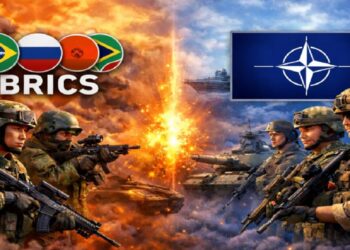


Palestine’s anticipated entry into BRICS marks a historic turning point in global geopolitics — one that transforms the bloc from a coalition of emerging economies into a movement of moral and political rebalancing. This development symbolizes what analysts are calling the “second wave of decolonisation,” connecting the 1955 Bandung Conference’s vision of sovereignty and equality to the realities of 21st-century multipolarity.
At its inception, BRICS was often described as a pragmatic alliance of emerging markets. Yet its philosophical core has always been decolonial — the assertion that the Global South will no longer be dictated to by the historic centres of imperial power. Palestine’s inclusion brings that vision full circle, embodying the unfulfilled promise of Bandung and the Non-Aligned Movement.
As Kwame Nkrumah once warned, “Neo-colonialism is the last stage of imperialism.” BRICS’ structure directly challenges this through de-dollarisation, the New Development Bank, and South-South cooperation — tools that reduce dependency on Western financial systems and promote genuine sovereignty.
According to political economist Dr. Leila Mansour, “Palestine’s membership would transform BRICS from a symbol of multipolarity into an engine of historical correction. It means that decolonisation is no longer rhetorical but institutional.”
This sentiment is echoed by Professor Samir Haddad, who notes that “BRICS provides Palestine not only moral recognition but economic instruments — development financing, trade partnerships, and political shield against marginalisation.”
Indeed, within BRICS, Palestine gains collective legitimacy. No longer a solitary actor in a skewed “peace process,” it would negotiate from a position of strength — backed by economies representing nearly half of humanity. This shift challenges the long-standing asymmetry of power that has defined its international relations.
Moreover, Palestine’s participation would redefine the bloc’s moral identity. For years, critics viewed BRICS as an economic forum without an ethical compass. Palestine’s presence anchors the alliance in the moral terrain of justice and liberation, reminding the world that multipolarity is not just power-sharing, but dignity-sharing.
As Nelson Mandela affirmed, “Our freedom is incomplete without the freedom of the Palestinians.” When Palestine takes its seat at the BRICS table, it will not only represent its people — it will carry the voices of all nations still bound by the chains of dependency.
This moment would not simply expand BRICS; it would complete the arc of decolonisation, bridging past struggles with the promise of a fairer world order.