
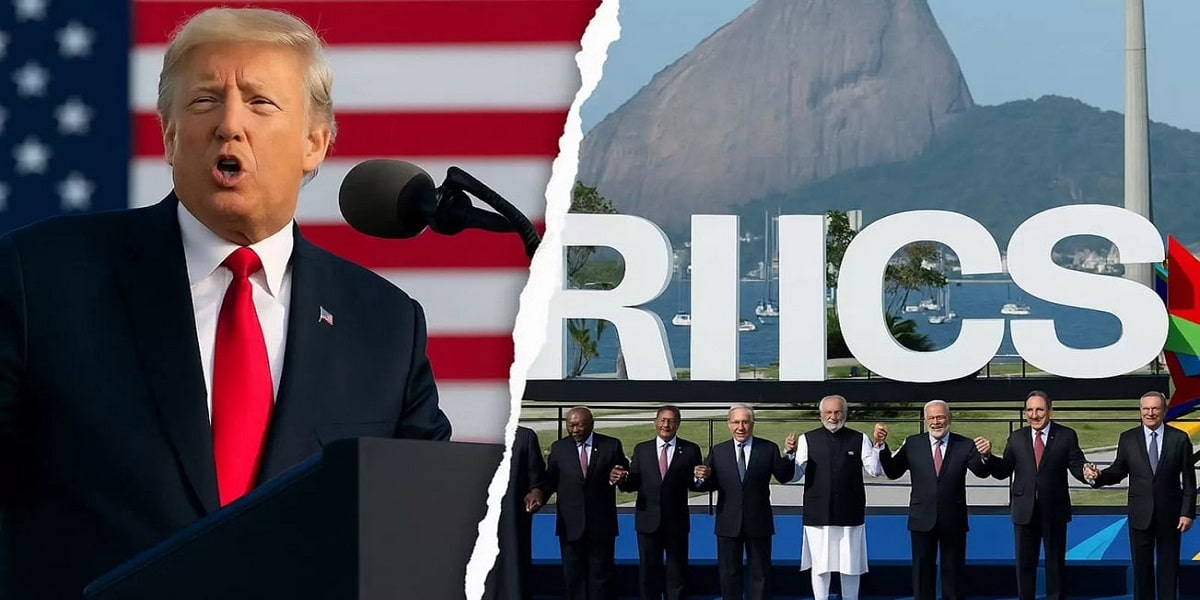
As BRICS expands its reach and influence, U.S. President Donald Trump is ramping up economic pressure against the bloc and its allies—fearing the challenge it poses to American financial supremacy. His latest move: a 30% tariff on South African exports and a fresh warning of a 10% tariff hike for any country aligning with what he calls BRICS’ “anti-American policies.”
“Trump has a reason to worry,” said Alicia Garcia-Herrero, senior fellow at Bruegel and chief economist at Natixis. “The BRICS is very clearly anti-Western. Part of its mantra is to change the global order.”
Despite the internal contradictions and logistical challenges within BRICS, its expanding membership is undeniable. From four original members, it now includes 10 countries with dozens more queuing to join.
Collectively, the bloc represents a quarter of global GDP and nearly half the world’s population. Their goal: reduce dependence on the U.S. dollar and rewire global trade around local currencies.
Russia and China are leading this “dedollarization” push, already conducting major energy trades in rubles and yuan. India, too, has sidestepped the dollar, paying for Russian oil in multiple currencies. Still, internal divisions have stalled more radical ideas, like the proposed gold-backed currency “Unit,” with India and Brazil favoring local currency trade instead.
Yet Trump remains unconvinced by the bloc’s limitations. In his words, “They’re going to be tariffs. Tariffs are going to be the tariffs,” adding a signature layer of confusion to policy.
South Africa was the first to feel the sting. On July 7, Trump imposed 30% tariffs on its exports, including citrus, wine, and nuts—key sectors supporting tens of thousands of jobs. “These industries are not abstract economic indicators; they are lifelines,” said Sonja Boshoff, chair of South Africa’s select committee on economic development and trade.
Dr. Peter Evans of the South African Pork Producers’ Organisation emphasized the fallout of U.S. pressure on local agriculture: “We’re just trying to keep our industry disease-free. Every time Agoa comes around, we have the same fight.”
Meanwhile, BRICS leaders have responded in kind. In a joint declaration from Rio de Janeiro, they condemned “unilateral coercive measures” that “skew global trade” and reaffirmed their push for a multipolar world order.
Still, experts argue the bloc has a long road ahead. “Trump shouldn’t be worried,” said economist Herbert Poenisch. “BRICS is still in the early stages, and bridging the many differences in priority will be a tall order.”
Nevertheless, Trump’s aggressive stance may inadvertently strengthen BRICS by accelerating its appeal among countries weary of Western dominance—risking the very shift he fears most.