

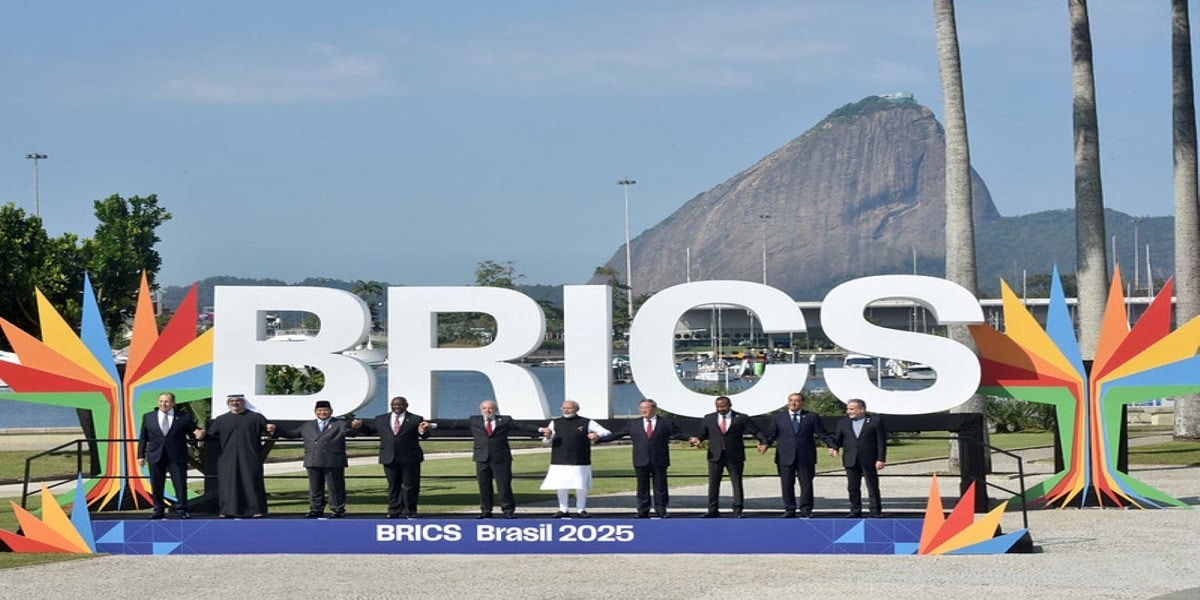
At the 17th BRICS Summit held in Rio de Janeiro in July 2025, the bloc of emerging economies took a surprising turn toward development-led multilateralism, pushing past internal rifts to present a bold agenda centered on sustainability, climate finance, and inclusive digital transformation.
Despite geopolitical fractures—Russia’s Vladimir Putin was absent due to an ICC warrant, and China’s Xi Jinping participated virtually—the summit, chaired by Brazil, redefined BRICS’ global posture. Under the theme “Strengthening Global South Cooperation for a More Inclusive and Sustainable Governance,” the Rio Declaration signaled a shift from rhetoric to action.
“This summit marks a turning point. BRICS is no longer content with critiquing existing global systems—it is building alternatives,” said Brazilian President Luiz Inácio Lula da Silva during the closing session.
A key highlight was the Leaders’ Framework Declaration on Climate Finance, which commits BRICS to mobilize $300 billion annually by 2035 for climate-related investments. The declaration calls for funds to be “accessible, timely and concessional,” addressing long-standing Global South grievances over restrictive global climate finance mechanisms.
Complementing this, Brazil introduced the Tropical Forests Forever Fund (TFFF) to reward forest preservation, potentially channeling $4 billion annually to countries maintaining low deforestation rates. Though innovative, it remains donor-dependent—raising questions about implementation.
To support private sector involvement, the summit launched the BRICS Multilateral Guarantee (BMG) facility aimed at de-risking sustainable infrastructure investments across the Global South.
BRICS also ventured into tech governance with the BRICS Leaders’ Statement on the Global Governance of AI. “AI must not be dominated by strategic rivalry. It must serve development,” emphasized India’s Prime Minister Narendra Modi. The bloc linked AI to the SDGs, from education to inequality reduction, and proposed a UN-led governance model prioritizing local innovation.
Beyond declarations, Brazil’s presidency championed operational tools: a BRICS Climate Research Platform, a Trade and Sustainable Development Laboratory, and an ESG-focused procurement seminar series were unveiled. These mechanisms aim to harmonize data, track green trade barriers like CBAMs, and align public spending with sustainability goals.
Yet challenges remain. The Rio Declaration sidestepped fossil fuel phase-outs and lacked detailed funding commitments. With India set to lead BRICS in 2026, the real test lies in translating Rio’s vision into measurable impact.
If successful, Rio 2025 may mark the moment BRICS evolved from a geopolitical forum into a developmental coalition capable of delivering on the Sustainable Development Goals (SDGs)—an outcome the Global South sorely needs.



